Related Posts
St Albans Parkrun Pain? When to See a Physio
Recurring pain can turn your Saturday 5K at Verulamium Park into a frustrating experience. Learn why running pain may keep coming back, when to adjust your training and how physiotherapy can help you return with greater confidence.
Gym Injuries in St Albans: When Should You See a Physio?
Not every ache after the gym means you need to stop training. Learn how to recognise when pain may need attention, when modifying your workouts could help and how physiotherapy can support your return to strength training.
Tennis, Padel and Racket Sports in Harpenden
Tennis and padel demand quick changes of direction, rotation and repeated overhead movements. Learn how to manage training load, recognise recurring problems and use physiotherapy to help keep small injuries from interfering with your time on court.
Knee Pain When Running: When Should You See a Physio in Bedford?
Knee Pain When Running: When Should You See a Physio in Bedford?
Running should be something you look forward to, not something you spend worrying about because your knee might start hurting again.
Knee pain is a common frustration for runners. It may begin as a slight ache halfway through a run, appear once you finish or only show up when you increase your distance or speed. Sometimes it disappears quickly. Other times, it becomes a problem that returns every time you try to progress.
One of the most common questions runners ask is whether they should stop completely or keep running through the discomfort. Unfortunately, there is no single answer that applies to everyone.
Running places repeated demands on the body, and most of the time we adapt extremely well to those demands. Problems can develop when training increases faster than the body is currently prepared for.
That might happen after increasing weekly mileage, adding more hills or speed work, returning after time away from running or adding several other forms of exercise into the week at the same time.
The location of knee pain can also vary. Some runners feel discomfort around or behind the kneecap, while others notice pain along the inside or outside of the knee or around one of the tendons.
The area that hurts can provide useful information, but it does not always explain the full problem. That is why an assessment looks at much more than the knee itself.
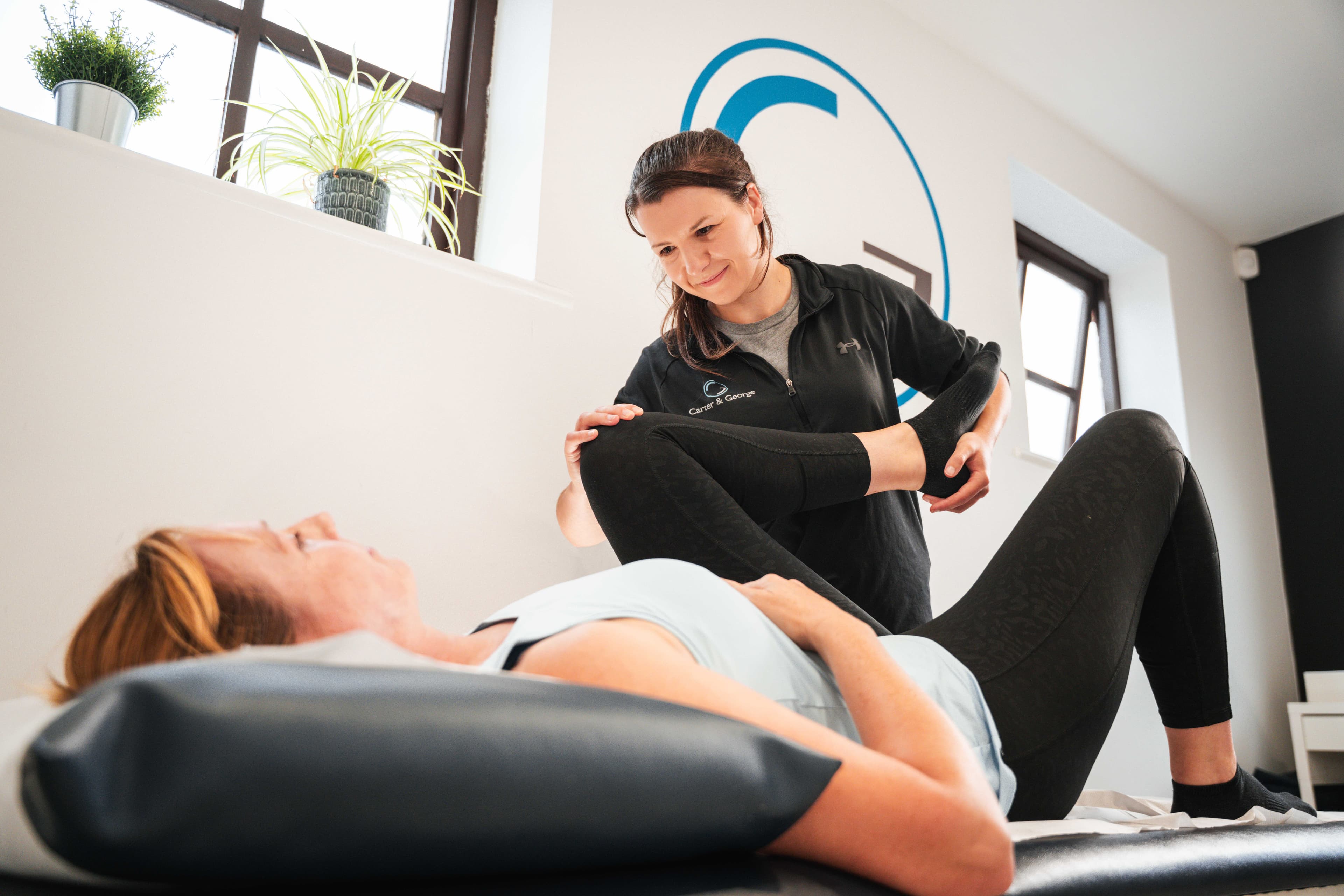
At Carter & George Bedford, a running-related physiotherapy assessment may consider your training history, recent changes in workload, previous injuries, mobility, strength and the specific demands of the running you want to do.
For some people, the answer may involve temporarily changing training rather than stopping completely. Distance, speed, frequency or terrain may be modified while rehabilitation focuses on rebuilding the strength and capacity needed for running.
This is important because feeling comfortable while walking does not necessarily mean the knee is ready for the repeated forces involved in a long run, sprint session or race.
Strength work can therefore be an important part of rehabilitation. The muscles around the knee, hip and lower leg all contribute to how the body manages load while running, and improving physical capacity can help prepare you for the demands of training.
There is also a psychological side to returning after an injury. Once knee pain has interrupted your training, it is easy to become hyper-aware of every sensation. A structured progression can help rebuild confidence as well as physical capacity.
If your knee pain keeps returning, is getting worse, changes how you run or prevents you progressing with your training, it is worth getting it assessed. The goal is not simply to tell you to stop running. It is to understand what is happening and help you work towards getting back to the miles you enjoy.
At Carter & George Bedford, our physiotherapists support runners and active people with injury assessment, rehabilitation and return-to-sport planning.
If knee pain is becoming a regular part of your runs, book a physiotherapy assessment with the Bedford team and start working towards a clearer route back to training.